- English
- 中文版


March 2026 ECB Preview: Looking Through The Energy Shock

Summary
- Standing Pat: The ECB should stand pat at the March meeting, maintaining the deposit rate at 2.00%, while reiterating familiar forward guidance
- Fresh Forecasts: Updated forecasts will likely point to a higher near-term inflation profile, and modestly slower short-run growth, though headline inflation should return to the 2% target over the medium-term
- On Hold For The Foreseeable: The base case remains that the easing cycle is at an end, and that the deposit rate will remain at 2.00% for the foreseeable, with policymakers likely to look-through the one-time impacts of an energy price shock
Standing Pat On Policy
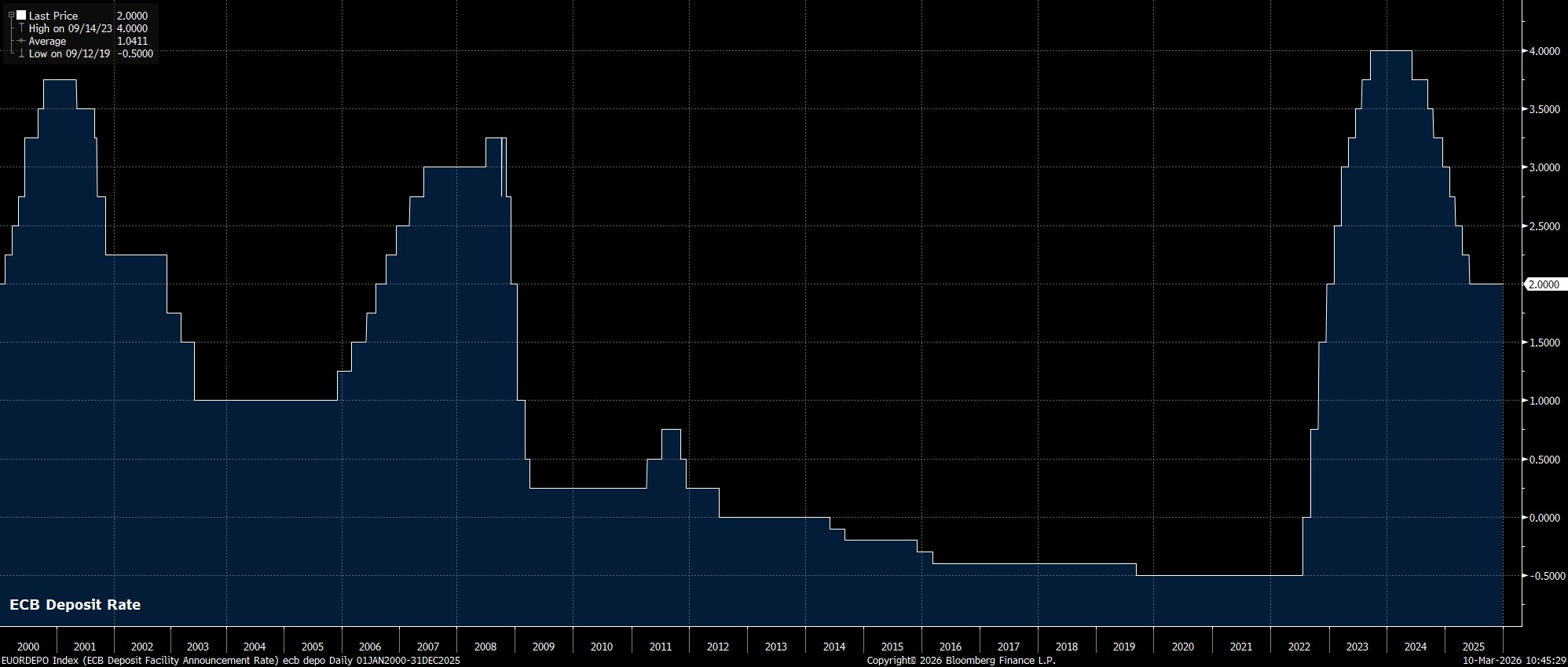
As noted, the ECB are set to stand pat at the second meeting of the year, maintaining the deposit rate at 2.00%, where it has stood since the easing cycle came to an end last summer.
It seems almost certain that the decision to stand pat will be a unanimous one among Governing Council members, while such a call would also be in line with market pricing, where the EUR OIS curve discounts no chance of any action this time around. Swaps, though, do discount around 18bp of tightening by year-end, though this seems largely a reflection of dovish STIR positioning in light of the recent bout of market turmoil, as opposed to outright bets on a particular policy path.
Familiar Guidance But With Caveats
Along with the decision to sit on their hands, the Governing Council are set to reiterate policy guidance with which market participants have now become incredibly familiar.
As such, the statement should reiterate that policymakers will follow a ‘data-dependent’ and ‘meeting-by-meeting’ approach, with there being no ‘pre-commitment’ made to following a particular rate path moving forwards.
That said, it seems likely that the statement will allude to the breakout of conflict in the Middle East, and the uncertainty that this has introduced to the outlook, chiefly through the form of a surge in commodity prices, as the Strait of Hormuz remains essentially impassable.
Forecasts To Reflect Energy Shock
That commodity shock will also be reflected in the updated round of staff macroeconomic projections.
On inflation, the December forecasts had pencilled in a modest headline HICP undershoot over the next two years, before a return to the 2% target in 2028. It is highly likely that this inflation profile is now revised notably higher, largely reflecting the jump in crude and natural gas prices over the last week or so, but also in light of a hotter-than-expected outturn in the February CPI report.
The crude futures curve suggests that headline CPI could rise to 2.2% at the end of this year, before accounting for any move in nat gas prices. However, there is every chance that the updated forecasts do not in fact take account of recent market moves, given that the projections usually take a snapshot of market-based variables three weeks prior to publication, meaning that they may well be conditioned on where assets were trading in mid-February.
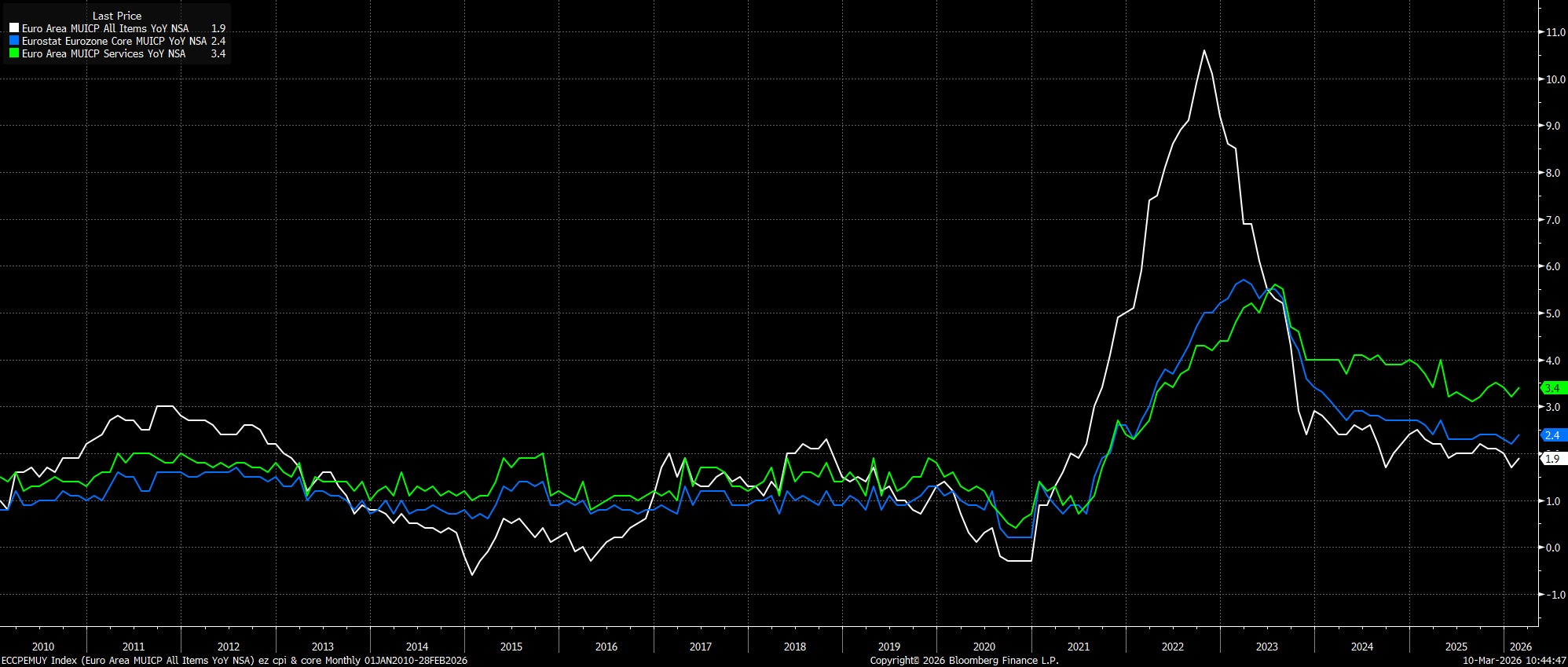
With that in mind, it seems likely that President Lagarde will stress that there is a significant degree of uncertainty around the macroeconomic outlook, and that it would be unwise to place too much weight on a forecast at this stage.
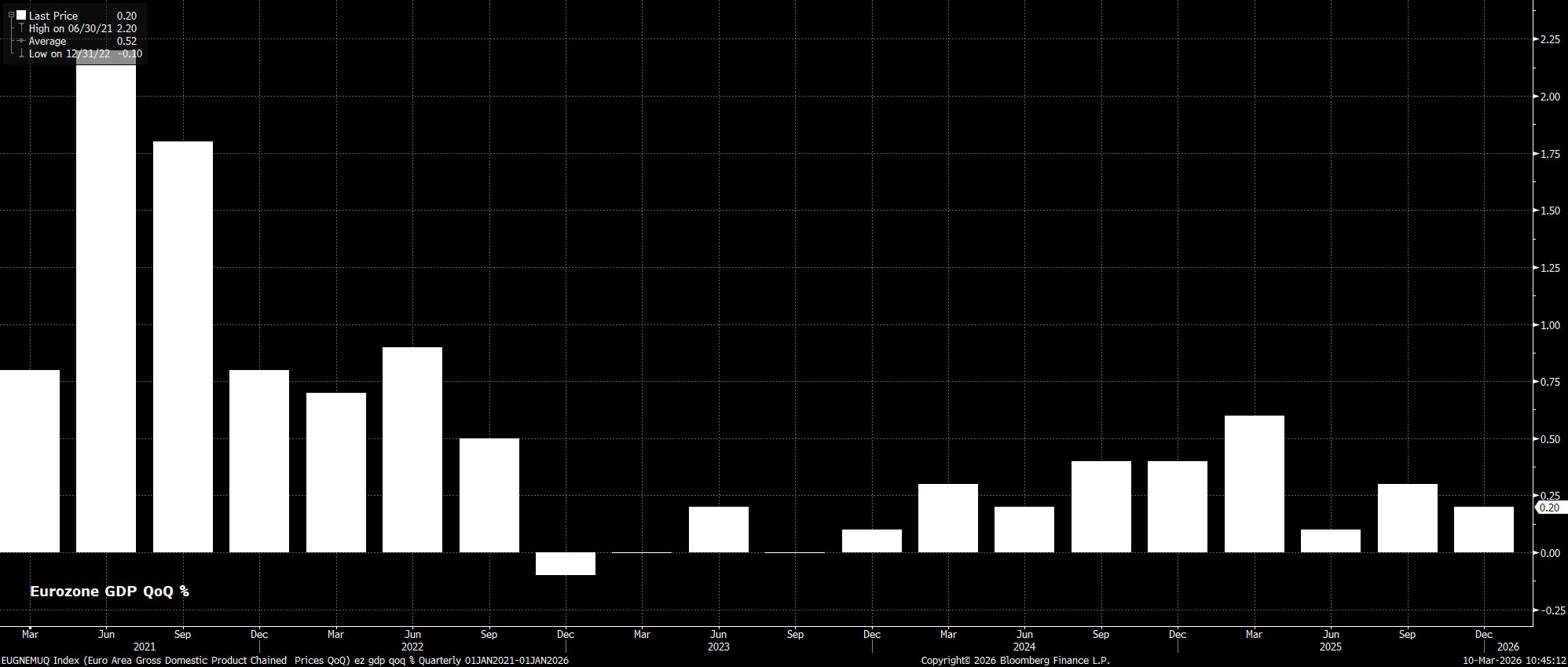
Similar applies in terms of expectations for eurozone GDP growth, where the impact of the recent surge in energy prices would argue for a near-term headwind, and subsequent downward revision to 2026 growth expectations, but is unlikely to have a prolonged impact further out the forecast horizon.
Lagarde To Stress Uncertainty & Flexibility
Meanwhile, at the post-meeting press conference, President Lagarde is likely, as mentioned, to stress not only the significant degree of uncertainty which clouds the outlook, but also that the ECB retain a large amount of flexibility – with rates essentially at a neutral level – to respond as appropriate depending on how the outlook evolves.
That said, Lagarde will likely reiterate that policy is still in a ‘good place’, but that such a place is not ‘fixed’, again providing policymakers with greater optionality in terms of the timing, and direction, of their next move.
As for other matters, it is somewhat inevitable that Lagarde will be asked on her future plans, as speculation continues to swirl that she may leave the ECB before her role as President ends next October, in an attempt to allow French President Macron a role in choosing her successor. Though Lagarde has already been asked on numerous occasions to deny these rumours, she has chosen not to do so, suggesting that this is probably a story where the adage ‘no smoke without fire’ applies.
Conclusion
Zooming out, it seems highly likely that the ECB will look-through any energy-induced inflation that may occur in the near-term. Not only does the traditional policymaking textbook augur for such action, the potential for second-round effects also seems relatively low, given the degree of labour market slack which remains.
Consequently, the base case remains that the ECB will remain on hold for the foreseeable future, with not even the Governing Council’s more hawkish members being inclined to push for policy tightening at this stage. Taking that into account, it remains likely that the deposit rate is held at its current level until at least the end of next year.
The material provided here has not been prepared in accordance with legal requirements designed to promote the independence of investment research and as such is considered to be a marketing communication. Whilst it is not subject to any prohibition on dealing ahead of the dissemination of investment research we will not seek to take any advantage before providing it to our clients. Pepperstone doesn’t represent that the material provided here is accurate, current or complete, and therefore shouldn’t be relied upon as such. The information, whether from a third party or not, isn’t to be considered as a recommendation; or an offer to buy or sell; or the solicitation of an offer to buy or sell any security, financial product or instrument; or to participate in any particular trading strategy. It does not take into account readers’ financial situation or investment objectives. We advise any readers of this content to seek their own advice. Without the approval of Pepperstone, reproduction or redistribution of this information isn’t permitted.