- English
- Italiano
- Español
- Français


Gold Outlook: Inflation and Rate Expectations Drive Trading, Geopolitical Risks Remain Key
.jpg?height=93&quality=100)
Gold has declined for eight consecutive trading days, with strong bearish pressure. However, the core of this pullback is not a fading demand for safe havens, but a shift in market trading logic—from “safe haven” to “inflation, interest rates, and liquidity.”
Rising energy prices have lifted inflation expectations, prompting markets to price in a more hawkish interest rate path, weighing on gold as a non-yielding asset. At the same time, heightened cross-asset volatility has increased liquidity needs, while the triggering of stop-loss orders and institutional rebalancing after key support levels were broken has further amplified gold’s downside pressure.
This week, developments in geopolitical tensions remain the market’s focus. If conflicts continue to push energy prices higher, gold may face further short-term pressure.
Technical Observation: Bears Dominate, Weekly Drop Exceeds 10%
Looking at XAUUSD daily charts, bears have maintained absolute control over the past week, with gold dropping more than 10%—the largest weekly decline since March 1983, nearly 43 years.
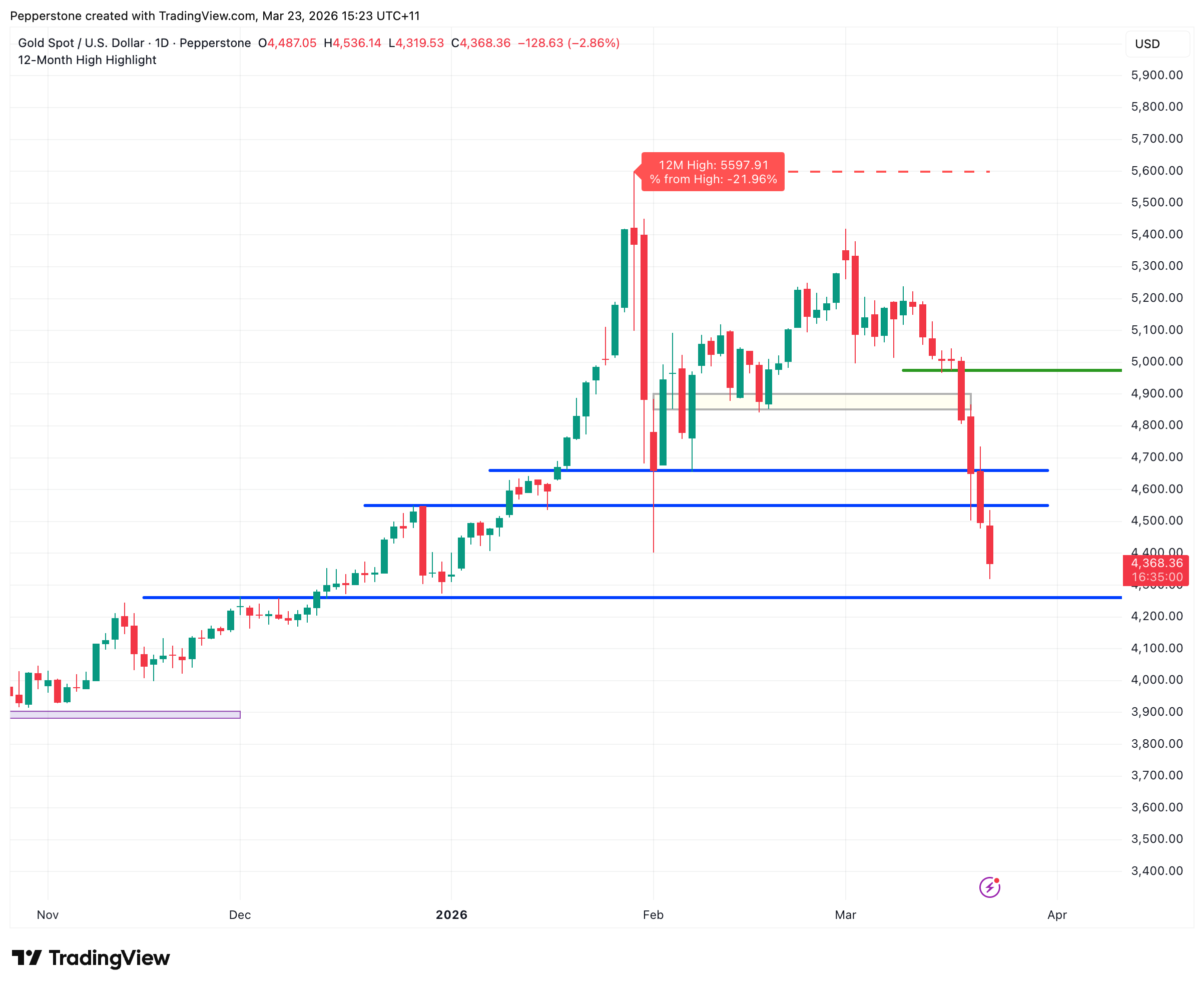
During this period, prices broke multiple key support levels at $4,850–$4,900, $4,660, and $4,550, which have now turned into resistance.
On Monday, gold extended its decline, falling below the October high of $4,380, nearly erasing all gains since the start of 2026. If bearish momentum continues, support near $4,260 and $4,000 should be closely watched.
Although gold’s safe-haven appeal and medium-to-long-term support remain intact, the current technical setup makes buying more akin to “catching a falling knife.” Position sizing and risk management are therefore more critical than heavy directional bets.
Three Key Drivers Behind Gold’s Decline
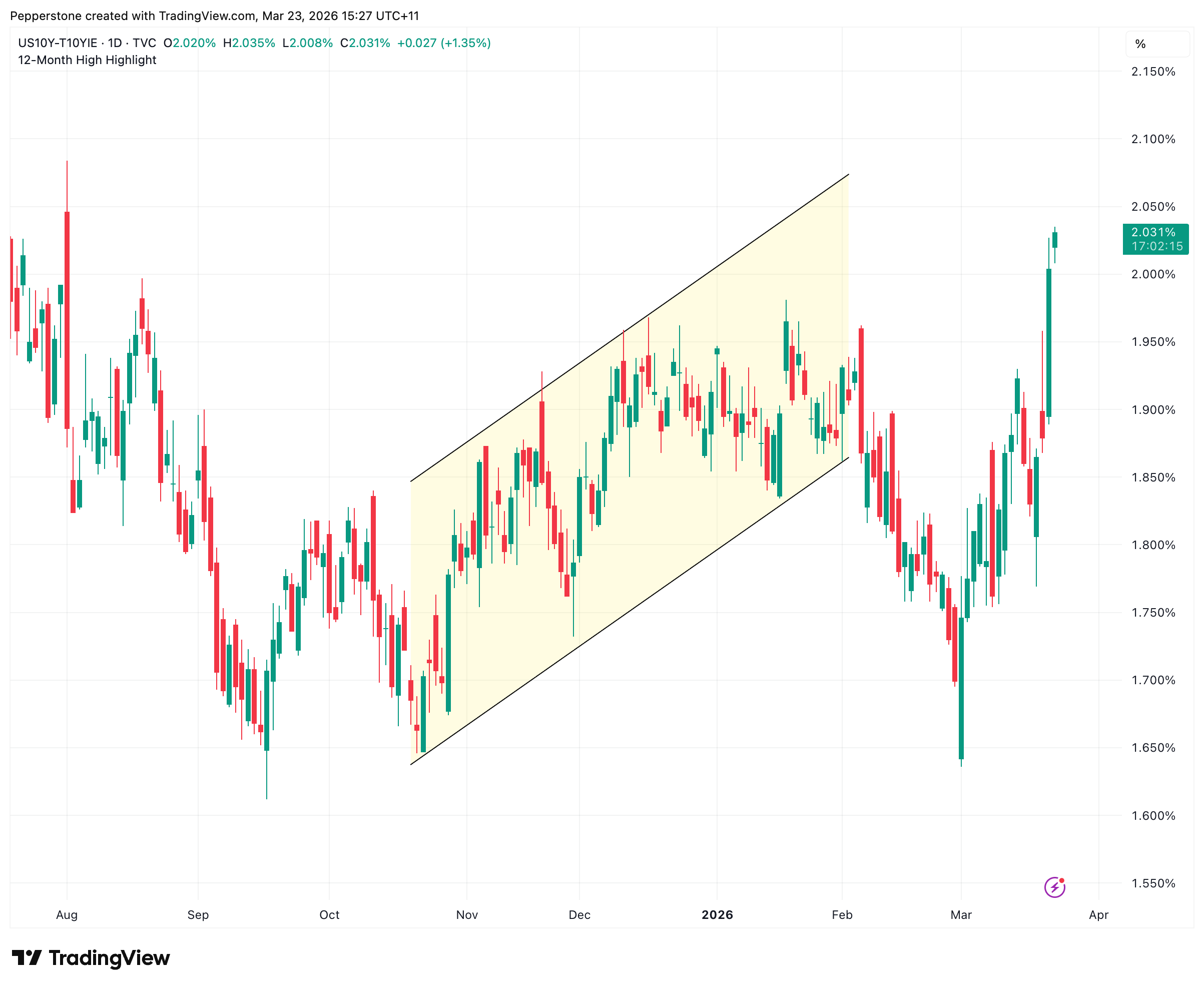
The main reason for the recent sell-off is that the market is prioritizing the transmission chain of oil prices, inflation, interest rates, and liquidity—not “safe-haven” demand. Geopolitical tensions remain unresolved, and high energy prices continue to push inflation expectations up. This dynamic is exerting more direct pressure on gold through the interest rate channel—long-dated U.S. Treasury real yields have risen sharply, with the 10-year real yield surpassing 2%, a new high since July 2025, and market pricing for the global rate path has turned clearly more hawkish.
From the Federal Reserve’s perspective, Powell’s remarks send a clear signal: inflation concerns now outweigh employment considerations. Although the dot plot suggests one rate cut in 2026 and one in 2027, internal divisions are widening.
Coupled with higher inflation expectations for 2026, swap markets have pushed back the timing of rate cuts to next year. The strong USD in this environment continues to weigh on gold.
For other major central banks—including the RBA, BoE, and ECB—traders are actively pricing in rate hikes this year, further reducing gold’s appeal as a non-yielding asset.
More importantly, market volatility itself is changing gold’s role. Selling pressure across equities, bonds, and credit markets has increased liquidity demand. In such conditions, assets sold first are often not the weakest fundamentally, but those that are most liquid, most profitable on paper, and easiest to cash out—criteria that gold perfectly meets.
At present, gold is behaving more like a “source of liquidity” rather than a traditional safe haven.
Additionally, gold’s strong performance over the past year has already priced in geopolitical risks, central bank buying, USD credit concerns, and expectations for monetary easing. In this context, ongoing conflicts may provide a window for profit-taking rather than acting as a catalyst for further price gains.
Inflation and Monetary Policy Are Driving the Market
Overall, the recent sharp pullback in gold reflects a shift in market focus—from risk itself to inflation trajectories and monetary policy constraints.
While many traders still treat gold as the “ultimate safe haven,” the market operates in layers. When risks emerge, capital first asks not “Should I hedge?” but “Which risks, with which assets, and by what means can I most efficiently mitigate them?”
Gold does not rise in every crisis. It is most effective at hedging medium- to long-term factors such as weakening monetary credit, falling real rates, and global imbalances.
However, during short-term shocks—particularly periods of liquidity tightening and rapidly rising rate expectations—gold may be sold first. Its “sentiment-driven” attribute is amplified when both allocative and trading capital dominate, increasing volatility during pullbacks.
Geopolitical Developments Remain Key
In the medium to long term, the core fundamentals supporting gold remain intact: geopolitical risks are becoming persistent, U.S. debt issues persist, and central bank purchases continue, all providing structural support for prices.
In the short term, however, geopolitical events can influence gold via the “energy–inflation–rate” channel, amplifying volatility and potentially keeping prices in a weak consolidation phase.
Even if technical indicators suggest following capital flows, heavy directional bets are risky, and risk management is essential.
The market remains focused on geopolitical developments. Over the weekend, Trump posted on Truth, demanding that Iran reopen the Strait of Hormuz within 48 hours (as of Tuesday 10:44 am AEDT). If no progress is made, attention will quickly shift to potential U.S. actions and Iranian responses. Any escalation could further drive up energy prices and inflation expectations, adding additional pressure on gold.
Meanwhile, with India’s wedding season approaching, physical demand may offer some marginal support amid inflationary pressures, but it is unlikely to alter the overall pricing dynamics in the near term.
Related articles


The material provided here has not been prepared in accordance with legal requirements designed to promote the independence of investment research and as such is considered to be a marketing communication. Whilst it is not subject to any prohibition on dealing ahead of the dissemination of investment research we will not seek to take any advantage before providing it to our clients. Pepperstone doesn’t represent that the material provided here is accurate, current or complete, and therefore shouldn’t be relied upon as such. The information, whether from a third party or not, isn’t to be considered as a recommendation; or an offer to buy or sell; or the solicitation of an offer to buy or sell any security, financial product or instrument; or to participate in any particular trading strategy. It does not take into account readers’ financial situation or investment objectives. We advise any readers of this content to seek their own advice. Without the approval of Pepperstone, reproduction or redistribution of this information isn’t permitted.